Universe: Good day, dear one. We find you thoughtful again. May we ask why?
Alexandra (Me): Well, I do a lot of thinking, you know. I’m a curious person.
U: We do know. What in particular has caught your curiosity this time?
A: When I went on my morning walk yesterday, this phrase popped into my mind out of nowhere — “practising the art of being yourself.”
U: A fine art indeed.
A: Yes.
U: Nothing actually comes out of nowhere. If you were to hazard a guess, why do you think that idea presented itself to you?
A: I watched several videos on YouTube this week. One about the American 20th-century writer, Charles Bukowski, whom I knew nothing about until now, and a couple of filmed interviews with Brian Eno. Two unapologetic artists.
U: Tell us more.
A: Bukowski had a nightmare childhood. His mother stood by while his father thrashed him with a leather razor strap three times a week, every week. Unsurprisingly, he grew up to have alcoholism and dysfunctional, stormy relationships. He was also absolutely, prolifically and fanatically dedicated to writing. Despite earning the paltry sum of $47.00 in his first 20 years of writing and sending off his work to be continually rejected. Writing was his purpose, his passion, his raison d’être.
Then there’s Brian Eno, a gentle, wise wizard of creativity, whether it’s sonic or visual art. I find him and his views on art — all forms of art — uplifting. A breath of unpretentious fresh air in the midst of all the pontificating, promoting and propagandizing that goes on. Wonderful! I love how he talks about art as playing with something fluid and alive, rather than something you have to work at. That it’s something that expands boundaries, both personal and societal.
U: Ah yes. He did say:
“Children learn through play, but adults play through art. So I don’t think we stop playing. I think we just carry on doing it, but we do it through this thing called ‘art’.”
A: Right! What really struck me is his stance that “art” includes so many aspects of life:
“I made a list of things that I would put under that umbrella [of art]. Symphonies, perfume, sports cars, graffiti, needlepoint, monuments, tattoos, slang, Ming vases, doodles, poodles, apple strudels, still life, second life, bed knobs and boob jobs.”
Philosophy with a bit of humour!
Really every human being is a work of art, in my opinion. We all start out differently, with different conditions and experiences to use as our raw materials. And the grown ups around us instruct us how to shape ourselves and how to regard the world around us.
For many of us, when you’re a kid playing with your pencils and colouring book, for example, they tell you it’s wrong to colour outside the lines, or to put two particular colours together. That’s like saying don’t expand, don’t create anything different from the way it’s presented to you.
Some, like Bukowski, rebel and reject the restricting rules of engagement they’re expected to adhere to. He said this of poetry, but it also applies to living:
“The rule means nothing to the pure creator. There … isn’t any excuse for a creation crippled by directives of school and fashion, or the valetudinarian prayer book that says: form, form, form!! put it in a cage!
He was also a proponent of allowing ourselves space and error. Imagine! Having the freedom to make mistakes as part of the creative process!
U: Tell us what else you learned from Brian Eno.
A: That art — and maybe life too — is all about process. He says a work of art is an object that triggers a reaction, a new experience, in the viewer. I love that. Maybe being yourself works the same way. It’s not a finished project — it’s the ongoing experience of becoming.
U: Beautifully said.
A: I suppose that means I can stop thinking I’m supposed to be a final draft.
U: Indeed. You are a glorious work-in-progress. And that includes every version of yourself there has ever been, or will ever be.
A: Wow. So perhaps practising the art of becoming yourself is a more accurate description of the process.
U: Well said.
Nam-myoho-renge-kyo is the song of your greater self.
A: Thank you! You know, all this reminds me of what Nichiren Buddhism teaches about the lesser self and the greater self.
U: Ah yes. The lesser self — the small, fearful identity that sees itself as completely separate. Always worried about comparisons and feeling either superior or inferior.
A: And the greater self — that vast, luminous part of us connected to all that is. As Daisaku Ikeda said:
“The purpose of Buddhism is to enable people to reveal their greater self — a self that is one with the universe.”
U: Quite right. Your greater self doesn’t audition for approval. It just shines, naturally and beautifully, like a star in the night sky.
A: Whether people notice or not.
U: Precisely. To practise the art of being -— or becoming — yourself is to keep remembering that you’re here to shine, right now, just as you are. You don’t have to wait until some fictitious day when you’re “perfect.”
A: So how do I actually practise this art?
When you chant you use your voice and your mind -— two powerfully creative elements -— to return to your original state of being — Buddha.
U: Start by noticing what feels true for you. Where you contract, where you expand. And when in doubt, chant.
Chanting is how you tune yourself back to your own true frequency. Nam-myoho-renge-kyo is the song of your greater self.
A: That’s lovely.
U: And remember what the humanistic psychologist, Carl Rogers, said:
“When I accept myself just as I am, then I can change.”
So acceptance isn’t the end of growth — it opens the door to growth.
A: That’s encouraging! So I can drop denial, regret, shame and other low-frequency self-judgements. Becoming and being my true self is really a daily act of remembering who I really am. Returning to who I really am.
U: Yes. A seldom mentioned meaning of the sound “Nam” in Nam-myoho-renge-kyo is to return. When you chant you use your voice and your mind — two powerfully creative elements — to return to your original state of being — Buddha. And like singing a melody you love, each time you sing it, it sounds a little different — and more you.
The art of being yourself is never finished, dear one. Like the Universe itself, of which you are an integral part, there is no limit to your expansion. That’s what makes it -— and you -— so beautiful.
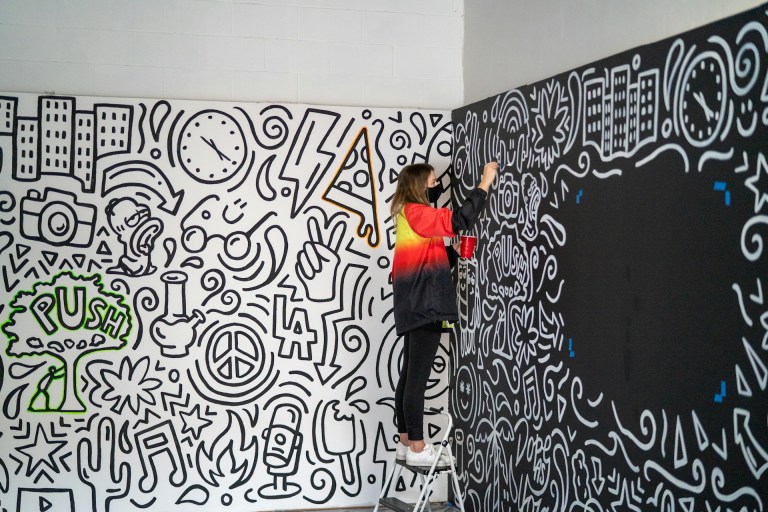
Photo by Marty O’Neill on Unsplash

 Posted by
  WHOLEHEARTED